Japan Garbage Collection Days: Find Your Ward Schedule
Find burnable, recyclable, non-burnable, and bulky-waste collection days in Japan using official ward schedules, address tables, and reminder tools.
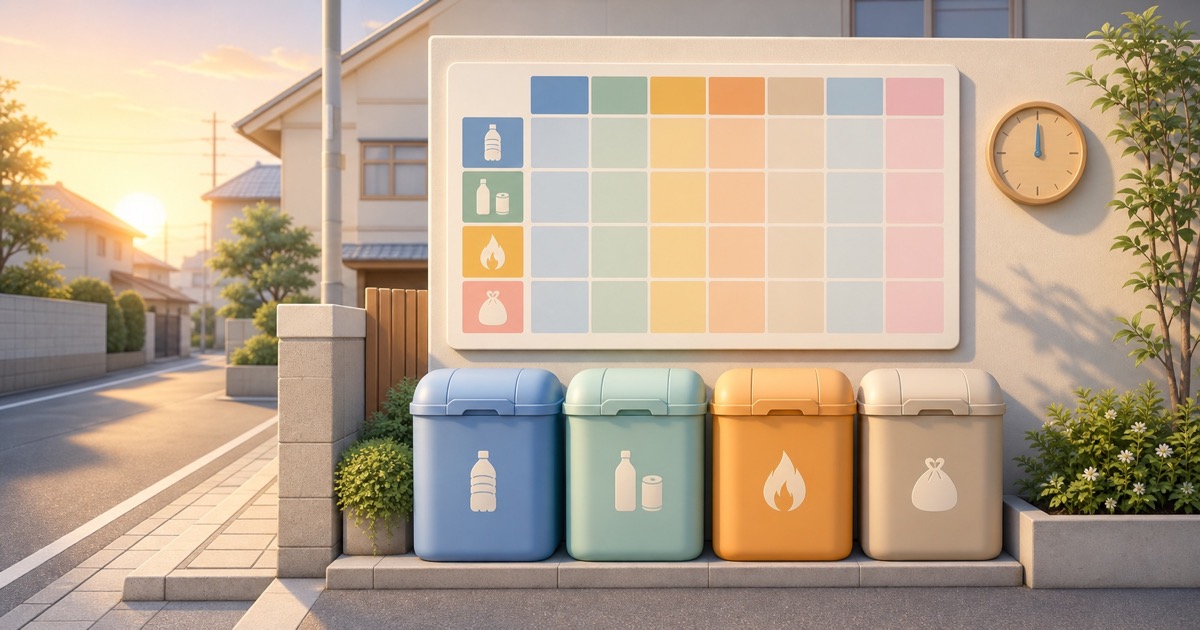
One of the most confusing parts of living in Japan as a foreigner isn't the sorting rules — it's figuring out which day to put out which garbage. Japan's waste collection system doesn't have a single schedule. Every city, every ward, and often every neighborhood has its own garbage collection calendar.
Put your burnable garbage out on the wrong day? It won't be collected, and it will sit there until the right day comes. Forget that Monday is non-burnable day? You'll have a pile of clutter at home for another two weeks.
This guide explains exactly how Japan's garbage collection schedule works and how to find your specific pickup days.
How Japan's Garbage Collection System Is Organized
Unlike many countries where a single truck picks up all trash once a week, Japan's collection system separates waste by type — and each type has its own collection day and frequency.
The typical collection pattern for a Tokyo ward looks like this:
| Waste Type | Japanese | Typical Frequency |
|---|---|---|
| Burnable garbage | 可燃ごみ | Often multiple times weekly; check locally |
| Non-burnable garbage | 不燃ごみ | 1–2 times per month |
| Recyclable (PET bottles) | 資源ごみ(PET) | Once per week |
| Recyclable (cans & glass) | 資源ごみ(缶・ガラス) | Once per week (different day) |
| Recyclable (paper & cardboard) | 資源ごみ(紙類) | 1–2 times per month |
| Oversized waste | 粗大ごみ | Appointment-based |
The result: on any given weekday, something is being collected. You need to know which day applies to your specific garbage type and location.
Why Every Area Has a Different Schedule
Japan's waste management is operated at the local municipality level — not nationally. Tokyo alone has 23 wards (特別区), each with its own waste management office and its own collection schedule. The schedule for Shibuya-ku may be completely different from Shinjuku-ku, even though they share a border.
Beyond the wards, each area within a ward may further have slightly different collection zones and days. Japan's system is hyper-local by design, which makes it precise but confusing for newcomers.
How to Find Your Garbage Collection Schedule
Method 1: Your Ward's Official Website
Every ward and city in Japan publishes its garbage collection calendar online. Go to your ward's official website and search for:
- ゴミ収集カレンダー (garbage collection calendar)
- ゴミの出し方 (how to put out garbage)
- 家庭ごみ 収集日 (household garbage collection day)
These pages usually have an address search tool where you input your specific address and get your exact collection day for each waste category.
Example URL patterns:
- Tokyo:
[ward-name].tokyo.jp/gomi - Osaka:
city.osaka.lg.jp
Method 2: The Paper Calendar in Your Mailbox
When you first move into an apartment in Japan, the building manager or ward office will often provide a paper waste collection calendar — a printed schedule showing each collection type by day for your specific area. Many landlords include this in the welcome packet.
If you didn't receive one, ask your building manager (管理人) directly.
Method 3: Ask at the Ward Office (区役所)
Visit your local ward office (区役所 / kuyakusho) and ask for the garbage collection schedule for your address. They will provide a printed calendar specific to your building's area — usually within minutes. This is especially useful when you've just moved in.
Method 4: The GomiSense App
The GomiSense app includes a collection calendar feature that shows your specific garbage collection days based on your neighborhood. Set your address once, and the app will:
- Show today's collection type
- Show this week's full schedule
- Send you morning notifications before each collection day
This is the most convenient method for newcomers who don't read Japanese fluently.
What Time to Put Garbage Out
This is crucial: put your garbage out on the morning of collection day, not the night before.
- Target time: The set-out window shown by your municipality or building
- Absolute deadline: The posted local deadline; do not estimate from another ward
- Do NOT put garbage out the night before (crows and other animals will scatter it)
Some areas designate a specific "garbage station" (ゴミステーション) — a shared collection point, often protected by a net — where all residents of the building or block leave their garbage on collection day morning. Find out where your building's garbage station is during your first week.
What Happens If You Miss Collection Day?
If you miss the collection day, your options are:
- Wait for the next collection — Check the official calendar for the next date; frequency differs by area
- Non-burnable and paper — These are only collected 1–2 times per month, so missing them can mean a multi-week wait
- Oversized waste — These require booking an appointment regardless, so there's no "collection day" to miss
Never put garbage out on the wrong day. Collectors will leave it uncollected, and you'll get a yellow sticker. It's also considered very inconsiderate to neighbors.
Special Collection Days to Know
Oversized Waste (粗大ごみ)
Oversized items — furniture, bicycles, futons, large appliances — are not collected on the regular schedule. You must:
- Contact your ward's oversized waste collection service by phone or online
- Schedule a pickup date
- Purchase a sticker (粗大ごみ処理券) from a convenience store
- Place the sticker on the item and leave it at the designated collection point on your appointment day
Fees range from ¥200 to ¥2,000+ depending on the item.
New Year Holiday Schedule
Japan has a garbage collection hiatus around New Year (roughly December 29 – January 3). This varies by municipality. Stock up on storage space in late December and check your ward's holiday schedule in advance.
O-Soji (大掃除) Season
In December, many Japanese households do a thorough annual cleaning (大掃除 / o-soji). This generates extra non-burnable and oversized waste. Wards often add extra collection dates in late December — check your ward's announcement.
Typical Weekly Garbage Schedule Example (Tokyo, Shinjuku-ku)
Here's an example of how a collection week might look in a typical Tokyo ward:
| Day | Collection |
|---|---|
| Monday | Burnable garbage |
| Tuesday | Cans (recyclable) |
| Wednesday | Burnable garbage |
| Thursday | PET bottles (recyclable) |
| Friday | Burnable garbage |
| 1st & 3rd Saturday | Non-burnable garbage |
| 2nd Saturday | Paper & cardboard (recyclable) |
| 4th Saturday | Glass bottles (recyclable) |
Your area will have a different configuration. The point is: on nearly every weekday, something is being collected.
Morning Reminder Tips
Set recurring phone alarms for each collection type:
- Burnable: Monday, Wednesday, Friday (or your area's days)
- Non-burnable: 1st and 3rd Saturday (or your area's days)
- Recyclable: The specific weekly day for your area
Better yet, use the GomiSense app's notification feature — it pulls your exact schedule automatically based on your address and sends reminders on collection morning.
Summary: How to Always Know Your Garbage Day
- Find your ward's official website and search for your address
- Ask your building manager for the local garbage calendar
- Download GomiSense for an always-up-to-date schedule with morning reminders
- Never put garbage out the night before — morning only
- Find your garbage station during your first week in the new place
Once you know your schedule, Japan's collection system becomes completely predictable and easy to follow. The hard part is only at the beginning.
Related Guides
Back to BlogJapan Apartment Move-Out Trash Guide: What to Do With Your Garbage Before You Leave
Moving out of a Japan apartment? This checklist covers everything: how to dispose of furniture, appliances, food waste, and oversized items before you hand back the keys. Avoid deposit penalties and neighborhood complaints.
Read article →Where to Donate or Recycle Electronics in Japan (2026)
Find the correct route for old phones, PCs, TVs, batteries, and small appliances in Japan, including trade-in, reuse, retailer, and ward collection options.
Read article →How to Sort Garbage in Japan: The Complete Step-by-Step Guide for Foreigners
Confused about Japan's garbage sorting rules? This guide covers every category — burnable, non-burnable, recyclables, PET bottles, and large items — with practical tips for foreigners living in Japan.
Read article →